Norck uses strictly necessary cookies to run this site. With your permission, we would also use Google Analytics to see how the site is used, and Google Ads to measure our advertising. We do not sell your data.
You can change your choices at any time under Privacy choices at the foot of every page, or by writing to info@norck.com. See the privacy statement for details.
Stereolithography (SLA) 3D Printing Service: High-Precision, Smooth Finishes
Stereolithography is an additive manufacturing process in which a UV-sensitive resin is cured to produce parts and assemblies. It helps turn designs into scaled prototypes as close to the designed model. It is mainly used in the earliest stages of product development and can be used in conceptual models, functional prototypes, tooling, electronics, and medical industries.
3D printing requires 3D CAD models to print a part or assembly. The 3D models can be made using parametric CAD software such as Solidworks and CATIA V5, or Subdivision modeling software such as 3DS and Blender.
Trusted by Engineers and Researchers at Fortune 500 Companies for Precision Manufacturing
Trusted manufacturing experience with leading global companies.
Lockheed Martin
Nucor Insulated Panel Group
Sumitomo Electric Interconnect Products
Saint-Gobain Performance Plastics Pampus GmbH
3M
FritoLay
Parker Hannifin Corporation
Lear Corporation
Boston Scientific
General Dynamics – OTS Canada
Land O'Lakes
ITW Food Equipment
KLA-Tencor
Fastenal
Volvo Construction Equipment
Saft Batteries
Hemlock Semiconductor
How is it fabricated?
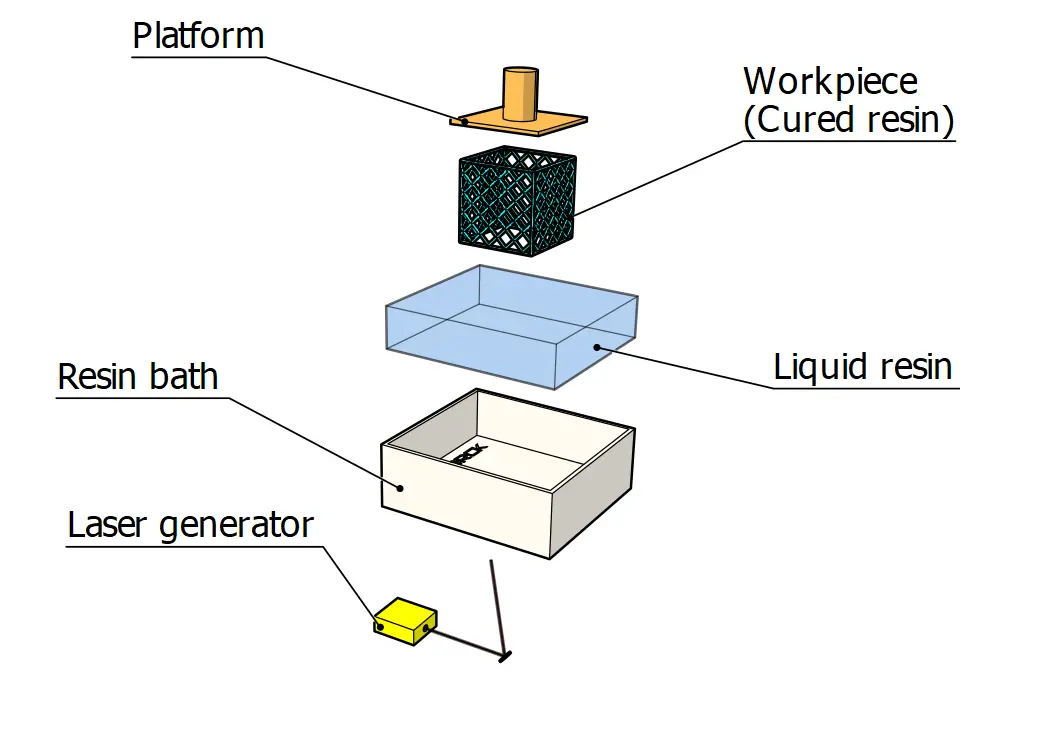
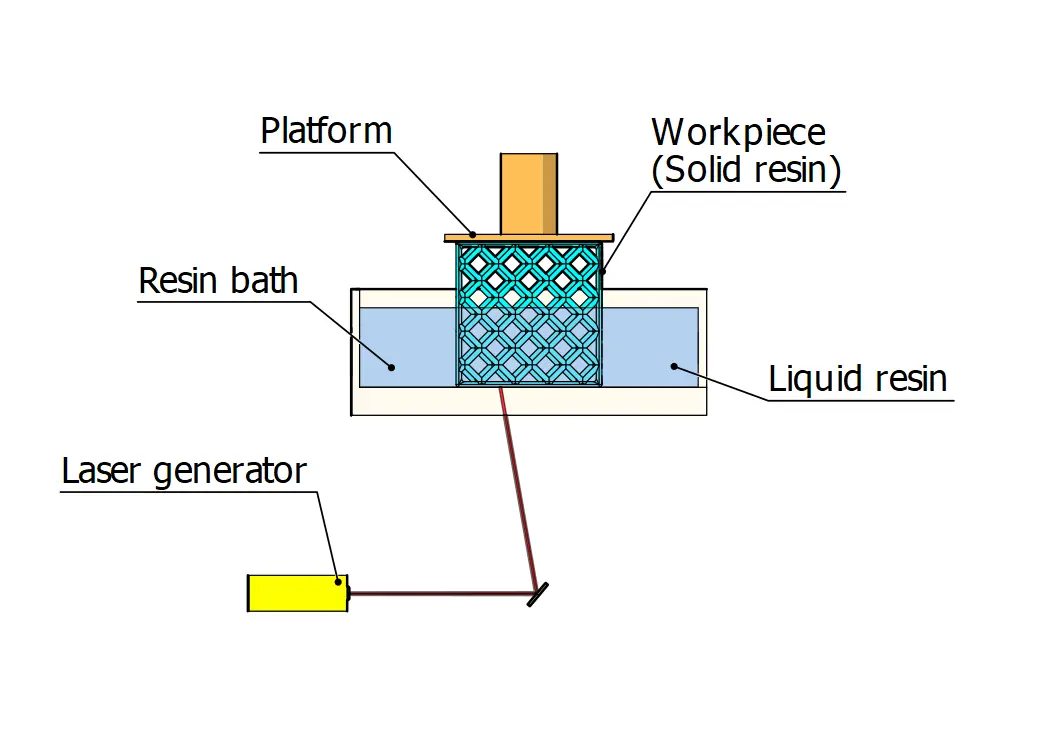
In Stereolithography, the 3D printer slices the 3D model into several cross sections and prints them layer by layer. A platform that will hold the model upside down is lowered into a UV-sensitive resin bath. Then a laser generator projects a cross-section on a transparent window under the resin bath, which will solidify the UV-sensitive resin. The hardened resin will be attached to the platform and pulled up. The platform will be lowered again for the next layer, which will be attached to the solidified layer.
Once the 3D printed model is finished, it can be removed from the platform and submerged in isopropyl alcohol to remove any excessive resin. Then the model gets exposed to passive UV light.
Stereolithography 3D Printing
Most used materials:•Polycarbonate-like Resin•Polupropylene-like resinParts and assemblies should follow specific design rules to be printed correctly. Norck offers engineering services that will help you confirm your design for 3D printing.
What are the advantages & disadvantages of using stereolithography?
Stereolithography is used over other 3D printing processes due to: - Fast process - High surface finishing - Accurate features
Although there are disadvantages to using stereolithography: - Requires post-processing - Requires a supporting structure - Weaker parts - Limited materials
Norck: Achieve Intricate Detail & Precision with Stereolithography (SLA)
Norck delivers expert stereolithography services and stereolithography 3D printing solutions, empowering engineers, designers, product developers, and manufacturers to create prototypes and end-use parts with exceptional accuracy, smooth surfaces, and complex geometries.
Norck's Engineering Edge: It's About More Than Just Aesthetics
Design for Additive Manufacturing (DfAM): Guidance on optimizing your designs to leverage SLA's strengths, minimizing print time and material usage.
Materials for Functional Prototyping: Selecting resins that mimic the look, feel, and even some mechanical properties of your intended production materials.
Process Optimization: Fine-tuning print parameters, orientation, and supports to achieve optimal accuracy, surface quality, and material properties.
Focus on Critical Applications: Extensive experience using SLA for medical models, product prototypes, jigs/fixtures, and other applications where detail matters.
Norck: Your Data-Driven Partner for On-Demand Manufacturing Excellence
Norck is a technology-powered manufacturing leader specializing in CNC machining, 3D printing, sheet metal fabrication, and injection molding. Our intelligent, data-driven approach ensures exceptional quality, optimized costs, and seamless supply chain management for companies worldwide.
Experience the Norck difference. Get a quote fast for your manufacturing needs today!
Frequently Asked Questions
1. What is Stereolithography (SLA) and what is it used for?
Stereolithography (SLA) is an additive manufacturing process that creates parts directly from digital designs by curing liquid resin layer by layer. Stereolithography 3d printing is commonly used to produce prototypes, functional models, and low-volume production parts with detailed features and complex geometries. As part of professional stereolithography services, it helps accelerate product development and efficiently evaluate new designs.
2. What are the benefits of Stereolithography 3D Printing?
Stereolithography 3d printing enables manufacturers to produce accurate prototypes and functional parts with shorter product development cycles. The process supports rapid design validation, engineering evaluations, product iterations, and low-volume production, making it an efficient manufacturing solution for a wide range of applications.
3. When should I choose SLA for my project?
SLA is well suited for rapid prototyping, design validation, functional testing, and low-volume production when projects require detailed features, complex geometries, and efficient product development. It helps manufacturers evaluate and refine designs before moving to larger production volumes when appropriate.
4. What types of parts can be manufactured using Stereolithography (SLA)?
Stereolithography services are used to manufacture prototypes, functional models, and low-volume production parts directly from digital designs. The process supports the production of parts with detailed features and complex geometries for a variety of engineering and manufacturing applications.
5. How can I request a quote for a custom SLA manufacturing project?
You can request a quote by submitting your CAD files, technical drawings, material preferences, production quantities, and project specifications. Norck reviews your manufacturing requirements and recommends the most appropriate stereolithography 3d printing solution for your application. Contact Norck to discuss your project and request a custom quote.