 English
 Deutsch
 Español
 Français
 Italiano
 Nederlands
 Dansk
 Svenska
 Norsk
 Czech
 Polski
 Português
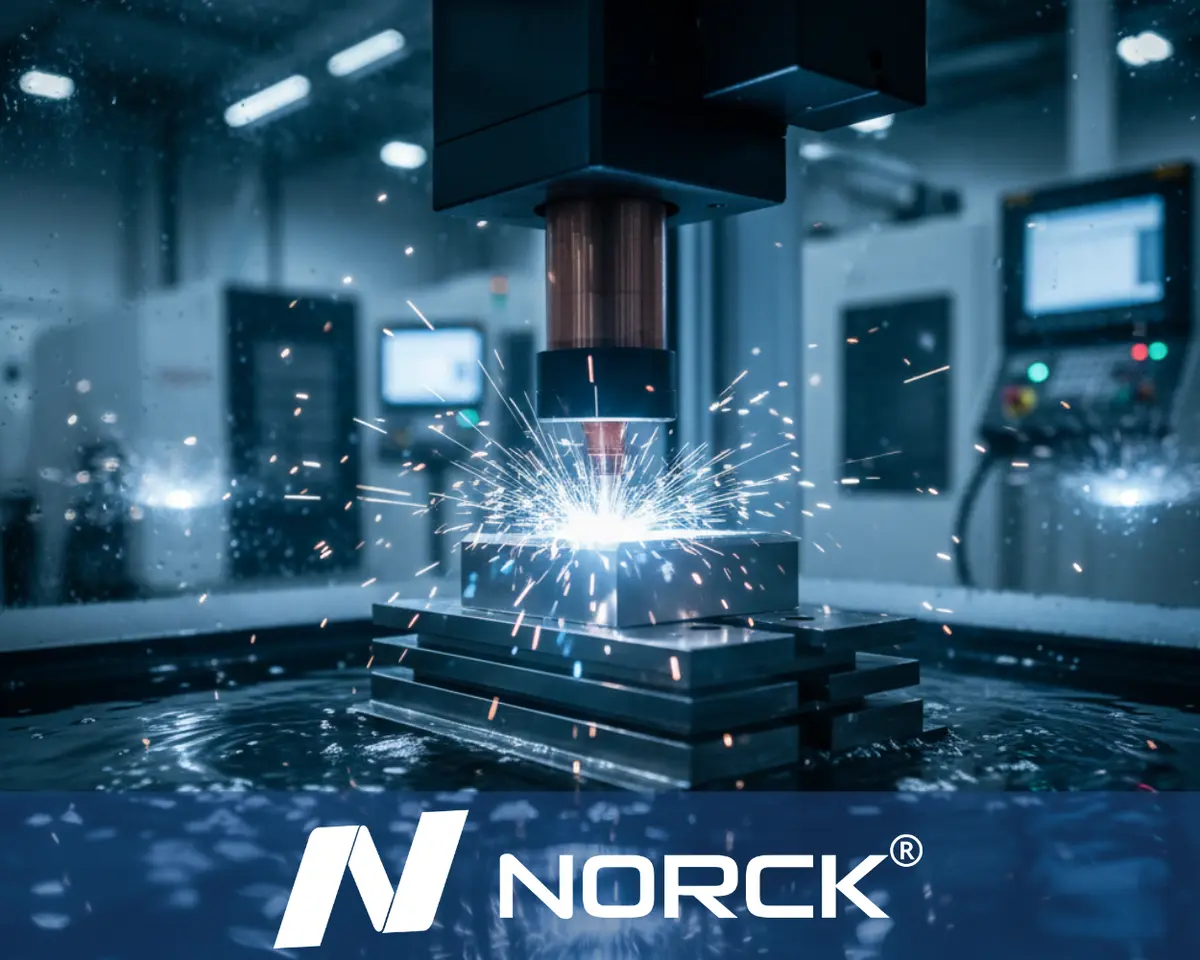
What Is Electrical Discharge Machining?
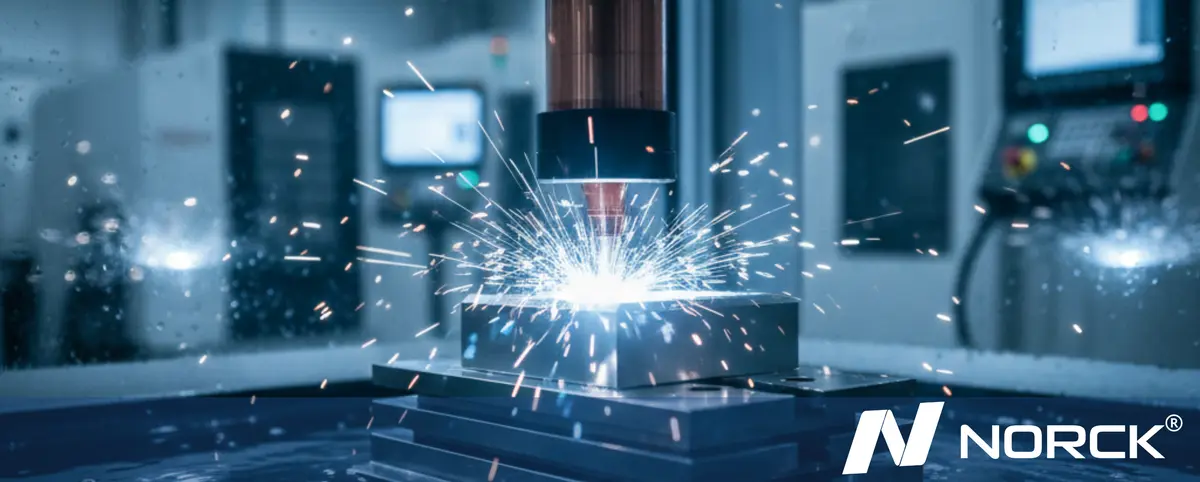
Electrical discharge machining definition: a non-conventional manufacturing method that removes material with controlled electrical sparks instead of mechanical cutting tools. The process uses rapid electrical discharges between an electrode and a conductive workpiece to gradually shape highly detailed, complex three-dimensional geometries. Since there is no direct contact between the tool and the workpiece, wire EDM services are a great choice for machining hard metals, delicate features, and complex contours that would be difficult or impossible to produce with conventional methods. For that reason, EDM is especially valuable in precision engineering industries such as medical, aerospace, and mold making.
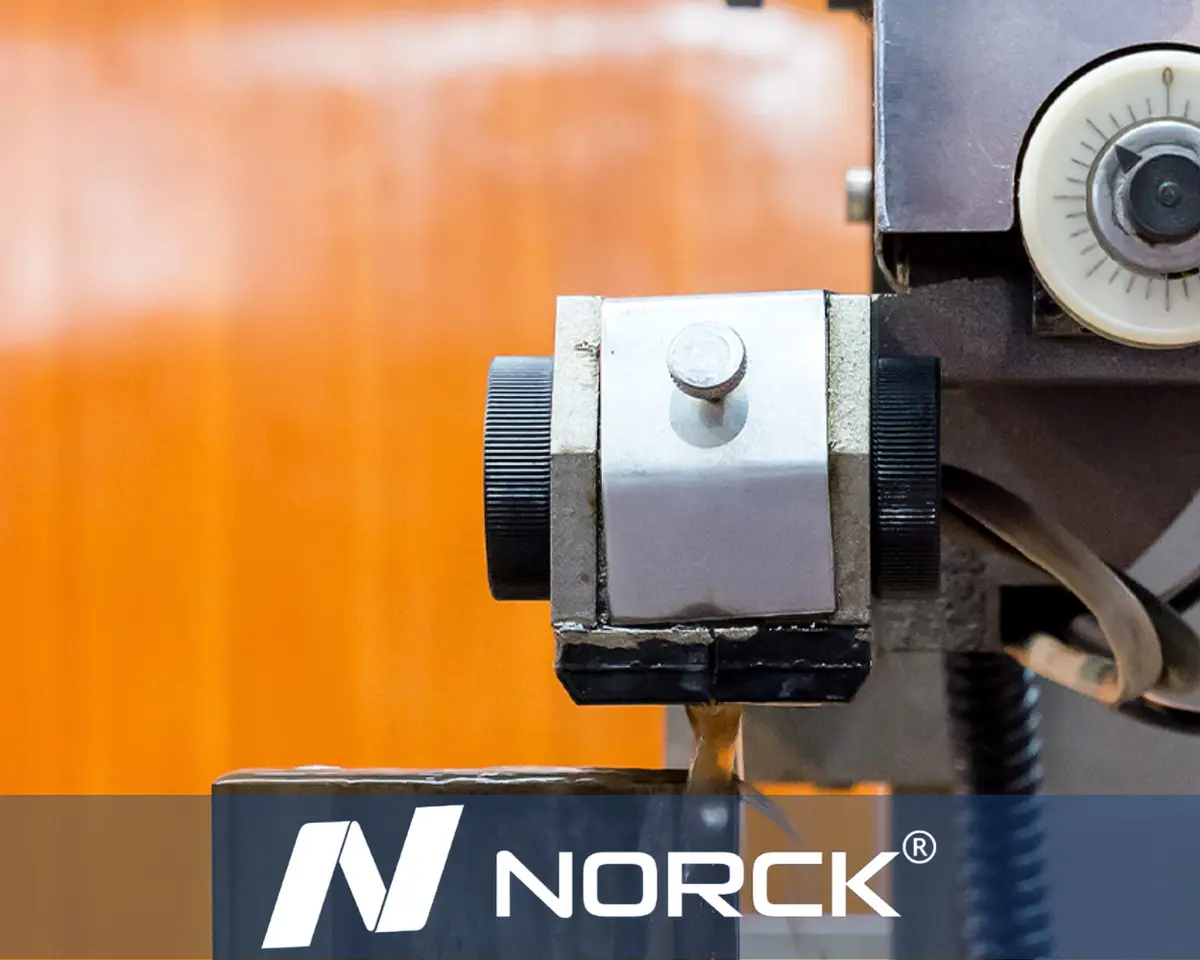
How Does Electrical Discharge Machining Work?
Electrical discharge machining (EDM) removes material through rapid, extremely localized electrical sparks (discharges) created between the tool electrode and the conductive workpiece. The dielectric fluid used as the machining medium insulates the gap and prevents a discharge until the electrode is close enough and the voltage high enough to ionize the fluid in a controlled way, allowing the spark to occur.
The fundamental characteristic of electrical discharge machining is its non-contact operation. EDM is also capable of achieving tight tolerances and fine surface finishes, making it an ideal machining process for specialized industries that require precision components.
What Is the Electrical Discharge Machining Process?
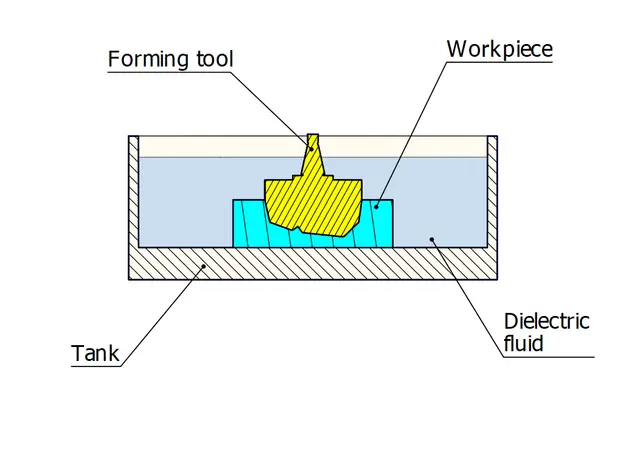
To explain clearly what is electrical discharge machining process, we can break it down into a few machining steps. First, both the workpiece and the electrode are submerged in a clean dielectric fluid, such as deionized water or hydrocarbon oil, which prevents premature sparking and provides the insulating medium required for a controlled energy discharge. Then, the machine applies a voltage between the electrode and the workpiece, which are separated by a small gap.
In a typical electrical discharge machining process diagram, a critical element is the servo system, which constantly adjusts the position of the electrode to maintain the proper spark gap. If the electrode is too far from the workpiece, no spark is generated. If the two are too close, a short circuit can occur and damage the electrode or the workpiece.
Key Components and Tools Involved in EDM
Every successful electrical discharge machining operation relies on a set of essential components that work together to maintain precision, stability, and repeatability. The electrode shape determines the final geometry on the workpiece, especially in die-sinking operations where intricate contours and cavities are needed.
Another vital component is the dielectric fluid, which acts as both an insulator and a coolant. This fluid prevents unintended sparking until the voltage reaches the correct threshold, then quickly cools the machining zone and flushes away eroded particles.
Support systems such as electrical pulse generators, filtration systems, and flushing systems provide additional stability and consistency. Together, these support systems allow electrical discharge machining services to produce detailed shapes, tight tolerances, and smooth finishes, even in extremely hard metals.
Types of Electrical Discharge Machining
Each of the types of electrical discharge machining includes several variations. The three main types of EDM used in modern manufacturing are described below.
Die-sinking EDM
Die-sinking EDM, also referred to as cavity or plunge EDM, is mainly used to produce complex molds, dies, and shaped cavities. It is especially useful in fields that require intricate geometries, such as injection molding, aerospace components, and medical tooling.
One of its greatest advantages is the ability to create sharp internal corners, deep cavities, and complex contours. This makes it one of the most widely recognized electrical discharge machining applications, especially where precision and surface quality are critical.
Wire-cutting EDM
Wire-cutting EDM slices through conductive materials with exceptional precision, using a continuously fed wire electrode, usually made of brass or tungsten. It is one of the processes used to manufacture punches, dies, gears, and other complex profiles that require extremely tight tolerances.
Wire-cutting is one of the most sought-after capabilities offered by electrical discharge machining manufacturers, especially when producing high-precision components for aerospace, robotics, and medical applications.
Hole-drilling EDM
Hole-drilling EDM, often called fast-hole EDM, specializes in creating micro-holes and deep holes. This process is well suited for producing cooling holes in turbine blades, micro openings in surgical instruments, and lubrication channels in high-performance mechanical systems.
One of the greatest advantages of hole-drilling EDM is its ability to create holes with extremely high aspect ratios. This makes the method ideal for producing starter holes in electrical discharge machining products that will later undergo wire-cutting operations.
Advantages & Disadvantages of Using Electrical Discharge Machining
To determine when EDM is the right choice, manufacturers should have a clear picture of the full range of electrical discharge machining advantages and electrical discharge machining disadvantages.
Electrical Discharge Machining Advantages
-
EDM can machine extremely hard materials such as carbide, titanium, and Inconel, which are very difficult to cut with conventional tools.
-
The method can produce very complex shapes and very fine details, which makes it suitable for high-precision applications.
-
Manufacturers can take advantage of EDM's ability to produce parts with fine surface finishes.
-
These finishes can reduce the need for secondary finishing operations.
-
It is capable of delivering very precise and repeatable results.
Electrical Discharge Machining Disadvantages
-
Because it requires electrically conductive materials, it has limited application in plastics, ceramics, and some composite materials.
-
Depending on the application, the cutting process can take longer than traditional machining, especially when large volumes of material must be removed.
-
The use of dielectric fluid creates maintenance and filtration requirements, which add to operational complexity.
Making high-quality electrodes for die-sinking EDM can be time-consuming and incur additional preparation costs.
What Are the Technological Parameters in EDM?
Understanding electric discharge machining parameters is essential because these parameters determine precision, productivity, and machining stability. The most influential parameter is the spark gap, the tiny distance between the electrode and the workpiece, which controls where and how each discharge occurs. The optimal gap allows efficient erosion while avoiding short circuits and unstable machining.
Other key parameters include peak current, which controls the intensity of each discharge, and duty cycle, which defines the share of ON time within each electrical pulse cycle (ON time plus OFF time). Flushing pressure plays a major role in removing debris, as it keeps the spark zone clear and prevents unstable machining.
What Materials Can Be Machined by EDM?
The electrical discharge machining application range is wide and covers tool steels, stainless steels, tungsten carbide, titanium, and nickel-based alloys. Most of these materials are used in high-performance applications such as aerospace turbines, injection molding, surgical tools, and energy systems.
EDM is also often the best option for exotic or heat-resistant metals, where mechanical machining causes heavy tool wear or tool deformation. Molybdenum, Inconel, cobalt-chrome, and hardened die steels are among the materials that benefit most from accurate, controlled thermal erosion. Even the most delicate features, such as thin sections or fine details, can be produced without distortion because no mechanical cutting force is applied.
What Software Is Used in EDM?
Modern EDM makes extensive use of sophisticated software that controls machining paths, fine-tunes parameters, and visualizes erosion patterns. Most electrical discharge machining suppliers rely on CAD/CAM platforms such as Mastercam, Autodesk PowerMill, and Siemens NX to design electrodes and generate optimized toolpaths. These systems enable engineers not only to visualize spark interactions but also to detect collisions and program the machining sequence.
Real-time feedback, adaptive spark monitoring, and automated calibration routines are combined into control systems that maintain consistent machining conditions over the long term. Together, these digital tools enable the best electrical discharge machining services 2025 to deliver high precision, efficiency, and repeatability across the most demanding applications.
Norck’s Expertise in Advanced EDM Solutions
Norck is one of the best electrical discharge machining manufacturers, known for its precision, innovation, and advanced engineering. Norck combines modern, sophisticated equipment with a team of highly trained specialists to ensure the highest degree of accuracy in applications that involve complex shapes and very tight tolerances. By consistently optimizing its electrical discharge machining (EDM) parameters, Norck has established itself as a leader in the aerospace, medical device, robotics, and automotive industries.
Norck's wire EDM services produce extremely precise profiles and tight corners while preserving the material's original properties, meeting the needs of customers who require the highest level of accuracy. Additionally, Norck provides expert CNC machining services for mass production, delivering a complete solution that covers every stage of the production process.