 English
 Deutsch
 Español
 Français
 Italiano
 Nederlands
 Dansk
 Svenska
 Norsk
 Czech
 Polski
 Português
From Requirement to Real Material: How Norck Brings AI-Powered Material Discovery to Engineering
Norck now helps customers discover, optimize, validate and manufacture advanced materials with MS Lattice. Here's how it works, and what it changes for engineering teams.
For most of manufacturing history, engineers have designed around the materials available to them. When a part needed to be lighter, stronger or more heat-resistant, the options were limited to what already existed on the market. If the right material wasn't there, the design had to compromise.
Norck is changing that. With our new AI-Powered Material Discovery, Optimization and Manufacturing service, we help customers find the material their product actually needs, prove it in the real world and build with it. It's one of the biggest steps in Norck's history: from manufacturing your parts to helping develop the materials they're made of.
Why materials are the next frontier in engineering
Every engineering team eventually meets a limit set by the material itself. A battery can only store as much energy as its cathode allows. A turbine component can only run as hot as its coating can survive. A magnet's performance depends on the rare earths it contains, and their supply.
Breaking through these limits has traditionally meant years of trial and error: testing known materials one by one and hoping one fits. That process is slow, costly and bounded by what's already on the shelf.
AI changes the starting point. Instead of asking "which existing material comes closest?", we can now ask "what material would deliver exactly what this product needs?" and search for it.
What is MS Lattice?
At the core of our new service is MS Lattice, a proprietary AI-powered material discovery engine developed by MatterSpace. Norck has licensed MS Lattice and integrated it into our engineering and manufacturing services.

MS Lattice works through inverse design. Instead of starting with a known material and asking what it can do, it starts with the properties your product needs and searches back to material structures that could deliver them. Three capabilities make that search work:
- Adaptive search: each round of results shapes where the next round looks, so the search follows the evidence rather than a fixed plan.
- Physics-based evaluation: every candidate is assessed against the properties that matter for your application.
- Structured validation: the strongest candidates are checked in recorded stages before they move forward.
The engine also keeps a diverse set of strong candidates rather than near-copies of one family, and stays within the chemistry and limits of each domain. The result is a shortlist built around your product, with the evidence behind every candidate.
Two ways to move beyond material limits
Not every project needs a brand-new material. That's why the service offers two paths:
Existing Material Optimization. We start from the material you already use and work to improve its performance and its fit to your technical requirements. For many products, this is the most direct route to better results.
Breakthrough Material Discovery. When today's materials simply aren't enough, we search beyond them for new materials with new properties and potential. The goal is solutions that can move your industry past its current technical limits.
Requirements first, preferences optimized
Every material project at Norck begins by separating two things:
- Requirements are the technical constraints your material must meet: the limits a candidate cannot cross. The search is built to find candidates that satisfy them.
- Preferences are the properties you'd like to push as far as possible, such as lower weight, higher efficiency or better stability. These are optimized on top of your requirements, never at their expense.
This distinction keeps the search focused on what your product truly needs, while still reaching for the best possible performance.
How the process works, step by step
What makes this service different is that it doesn't stop at a promising result on a screen. A material model is a starting point, not a result. Our process connects computational discovery with the physical world:
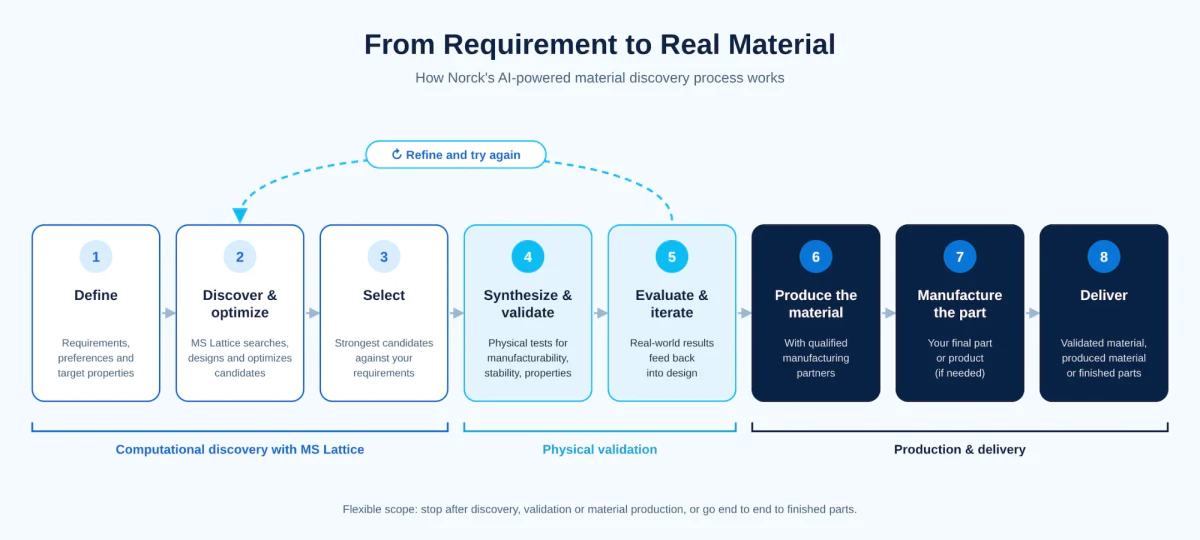
- Define. You share the properties you need, your requirements and your preferences.
- Discover and optimize. Using MS Lattice, we search, design and optimize material candidates computationally.
- Select. The strongest candidates are chosen against your requirements and target properties.
- Synthesize and validate. Candidates are synthesized and tested for manufacturability, stability and expected properties.
- Evaluate and iterate. Real-world results feed back into design. If a candidate falls short, we refine it and try again.
- Produce the material. Successful materials move into production with qualified manufacturing partners, whether that's a metal alloy, a battery material, a magnet or another advanced material.
- Manufacture the part. If you need it, we turn the new material into your final part or product.
- Deliver. You receive a validated material solution, produced material or finished parts, depending on your scope.
Material discovery is iterative by nature, and we've built the service around that reality. Candidates are tested, results are evaluated and designs are refined until the material is ready for real-world use.
Eleven material domains, one engine
MS Lattice works across eleven material domains, each with its own material groups, targets and starting points. Together they cover many of the materials behind today's most demanding technologies.
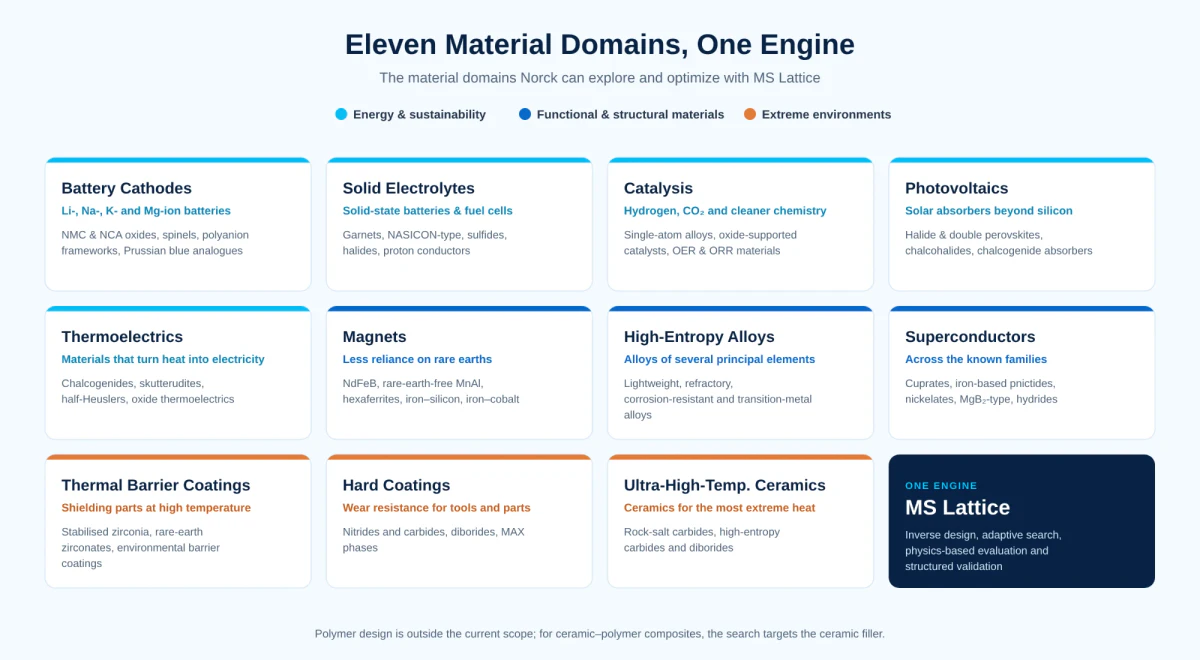
| Domain | What it covers | Material groups |
|---|---|---|
| Battery Cathodes | Cathodes for lithium-, sodium-, potassium- and magnesium-ion batteries | Layered NMC and NCA oxides, spinel oxides, polyanion frameworks, sodium-ion layered oxides, Prussian blue analogues, magnesium-ion spinels |
| Solid Electrolytes | Ion conductors for solid-state batteries, fuel cells and electrolysers | Garnets, NASICON-type conductors, sulfides, halides, oxide-ion conductors, proton conductors, ceramic–polymer composites |
| Catalysis | Catalysts for hydrogen, CO₂ conversion and cleaner chemistry | Single-atom alloys, alloy surfaces, oxide-supported catalysts, acid OER anodes, ORR alloys, CO₂ reduction surfaces |
| Magnets | Permanent and soft magnets with less reliance on rare earths | High-performance and reduced-rare-earth NdFeB, rare-earth-free MnAl, hexaferrites, iron–silicon, iron–cobalt, spinel ferrites |
| Photovoltaics | Solar absorbers beyond silicon | Halide perovskites, double perovskites, chalcohalides, chalcogenide absorbers |
| Thermoelectrics | Materials that turn heat into electricity | Chalcogenides, skutterudites, half-Heuslers, oxide thermoelectrics |
| High-Entropy Alloys | Alloys of several principal elements | Transition-metal, corrosion-resistant, lightweight and refractory alloys |
| Superconductors | Superconductors across the known families | Cuprates, iron-based pnictides, bilayer nickelates, MgB₂-type compounds, high-pressure hydrides |
| Thermal Barrier Coatings | Coatings that shield parts at high temperature | Stabilised zirconia, rare-earth zirconates, high-entropy oxides, environmental barrier coatings |
| Hard Coatings | Wear-resistant coatings for tools and parts | Nitrides and carbides, diborides, MAX phases |
| Ultra-High-Temperature Ceramics | Ceramics for the most extreme heat | Rock-salt carbides, diboride composites, high-entropy carbides, high-entropy diborides |
A few examples of what this opens up:
- Energy storage: battery teams can explore cathodes and solid electrolytes for next-generation lithium-, sodium- and solid-state batteries.
- Extreme environments: aerospace and energy engineers can look for thermal barrier coatings and ultra-high-temperature ceramics that protect parts in intense heat.
- Supply resilience: magnet developers can explore designs with less reliance on rare earths.
- Lightweight strength: automotive and aerospace teams can investigate lightweight and refractory high-entropy alloys.
Designing polymers themselves is outside the current scope; for ceramic–polymer composites, the search focuses on the ceramic filler. If your need doesn't fit any domain, we'll tell you upfront, before a project begins.
What it changes for our customers
This is more than a new service line. It changes where Norck enters your product development process and what you can expect from one partner:

- We start earlier. Instead of joining when the design is finished, Norck can now help from the very first question: what should this part be made of?
- One partner, from material to part. Material discovery, validation, material production and part manufacturing are usually separate services, handed from one team to another. With Norck, they're managed as one connected process.
- Outcomes, not files. You don't receive just a list of candidates on a screen. You receive materials that have been tested, validated and fitted to your needs.
- Searches built around your product. Requirements and preferences are defined for your application, so the search targets what your product truly needs.
- A wider space to explore. AI-powered search lets teams look beyond the familiar shortlist of materials and consider options they might not have reached through trial and error alone.
- Confidential from day one. Projects can run under NDA from the first conversation.
Choose the scope you need
Developing a new steel alloy is one job. Machining your part from it is another. Not every project needs both, so you choose the scope that fits your program:
| Scope | What you get |
|---|---|
| Discovery | New material candidates or an optimized existing material |
| Discovery + Validation | Candidates synthesized and physically tested |
| Discovery + Validation + Material Production | A validated material, produced |
| End to End | From discovery to your final, manufactured parts |
Norck manages the process across every step you choose. For highly specialized materials and parts, we coordinate production with expert manufacturers that have exactly the right capabilities. And when it's time to turn the material into parts, our experience in CNC machining, sheet metal fabrication and 3D printing comes into play.
Built for ambitious R&D programs
The service is designed for organizations running large-scale R&D programs and pushing the limits of what materials can do, across Europe and the United States: aerospace & aviation, space technologies, defense, automotive, energy, battery technologies, advanced manufacturing, and high-tech engineering & R&D.
For many of these teams, the first project is a focused R&D or material development study. When it succeeds, it can grow into a larger, long-term industrial program.
Frequently asked questions
Do I always need a completely new material?
No. Many projects start by optimizing a material you already use.
Who do I work with?
With Norck. We manage your project from the first requirement to final delivery.
Is every new material guaranteed to work the first time?
Material discovery is iterative. Candidates are physically tested, and results feed back into the design until we reach a material that meets your needs.
Do you manufacture every material and part yourselves?
Norck manages the whole process. For specialized materials and parts, we work with qualified manufacturers that have the right capabilities.
Can I buy only part of the process?
Yes. Choose discovery only, add validation, add material production or go all the way to finished parts.
What if my material isn't in one of the eleven domains?
Describe your need and we'll tell you upfront whether a domain covers it. Designing polymers themselves is currently outside the scope.
A new chapter for Norck, and for your products
For years, Norck has helped companies turn designs into precision parts. With AI-powered material discovery, we can now help shape what those parts are made of, and carry the result all the way into the physical world.

It's a step from manufacturing toward advanced engineering and R&D, and we're excited to take it with our customers.
Have a material challenge? Tell us what your product needs. Our team will review your requirements and propose the right scope.